
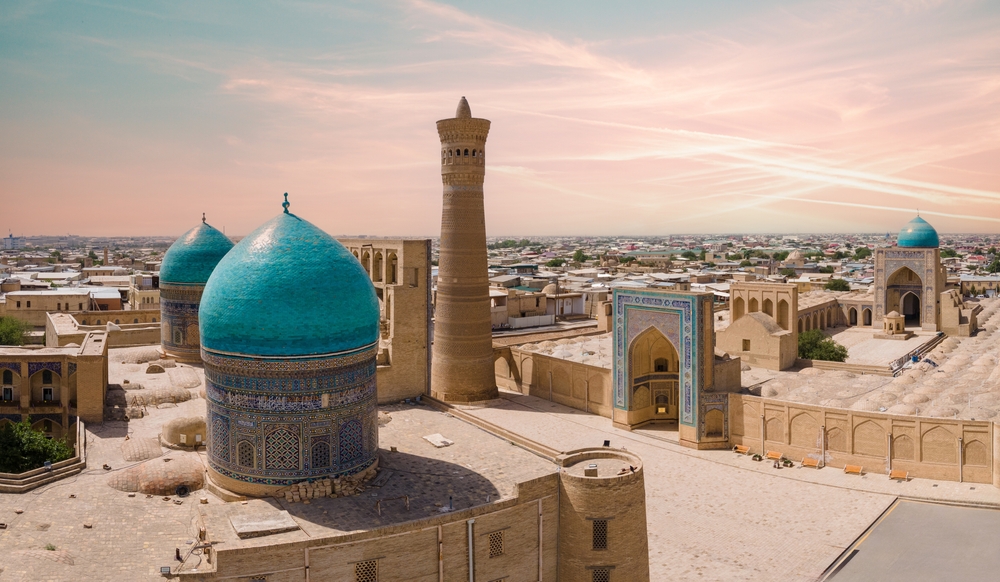
There are places that quicken the heart the moment you arrive, and Uzbekistan is one of them. Standing in the blue-domed cities of Samarkand and Bukhara, you feel that you have not so much discovered something new as returned to something familiar the sound of the adhan drifting over turquoise tiles, the hush of a courtyard at dusk, the sense that faith and beauty were once, in this corner of the world, the very same thing. On a Friday, when hearts turn toward gathering and gratitude, few destinations speak to the soul quite like this one.
A land that raised the teachers of the ummah
Long before it was a stop on any traveler’s list, Uzbekistan was a cradle of Islamic scholarship. Bukhara alone gave the ummah Imam Muhammad ibn Ismail al-Bukhari, born in the city in 810 CE, whose collection Sahih al-Bukhari remains among the most trusted compilations of hadith in Sunni Islam. He traveled for years, sifting thousands of narrations with painstaking care, and today pilgrims come to his memorial complex near Samarkand recently rebuilt and reopened during Ramadan 2026 to welcome far more worshippers to sit quietly near the resting place of a man whose life was spent guarding the words of the Prophet ﷺ.
To walk this land is to walk in the footsteps of scholars. It is a gentle reminder that knowledge, patience, and sincerity outlast empires and that the small, unglamorous work of seeking truth can echo for more than a thousand years.
Beauty built as an act of devotion
Samarkand’s Registan Square stops even the most seasoned traveler in their tracks. Three great madrasas, Ulugh Beg, Sher-Dor, and Tilya-Kori rise around an open plaza, their facades a shimmer of blue, gold, and geometric wonder. These were once universities where students studied Qur’an, astronomy, and mathematics beneath the same sky we stand under now. Nearby, the vast Bibi-Khanym Mosque, commissioned by Timur in the early fifteenth century, was in its day among the largest mosques in the Islamic world.
In Bukhara, the Kalyan Minaret has watched over the city since 1127. Rising some forty-six meters, it so awed Genghis Khan that, according to a beloved local legend, he ordered it spared while much of the city fell. For centuries it has called the faithful to prayer, a slender tower of baked brick that has outlived conquerors and dynasties alike. Wander a little further and you meet the whimsical four-towered Chor Minor, tucked into a quiet lane, proof that even the humblest streets here hold their own small marvels.
What moves the heart is not merely that these places are old, but why they were made. They were built as offerings, beauty raised toward the heavens, so that the act of worship might be surrounded by something worthy of it.
An easy place to be a Muslim traveler
For families seeking a journey that nourishes the spirit, Uzbekistan is wonderfully welcoming. Halal food is simply the norm — steaming plates of plov, fragrant samsa, and fresh non bread are found on nearly every corner. Mosques are everywhere and open, the pace is unhurried, and the famed Uzbek hospitality means guests are treated as a blessing to be honored. It is the rare destination where the practical needs of a Muslim traveler are met without effort, leaving the heart free to reflect.
A gentle invitation
As this Friday draws us toward stillness and gratitude, Uzbekistan offers a quiet lesson: that the things built with sincerity, a hadith carefully preserved, a courtyard laid with love, a minaret pointing ever upward, are the things that endure. Perhaps that is the real souvenir of a journey here: not a photograph, but a renewed sense of what lasts.
If your heart feels the pull of Samarkand’s domes and Bukhara’s ancient call to prayer, we at Dar El Salam Travel would be honored to walk that road with you. With more than thirty-five years of guiding Muslim travelers, we craft journeys that are comfortable, halal-friendly, and rich with meaning so all you need to bring is an open heart.
Jummah Mubarak from all of us at Dar El Salam Travel.
Recent Comments